
MIPI Monitoring Board
SVL-03-UVC
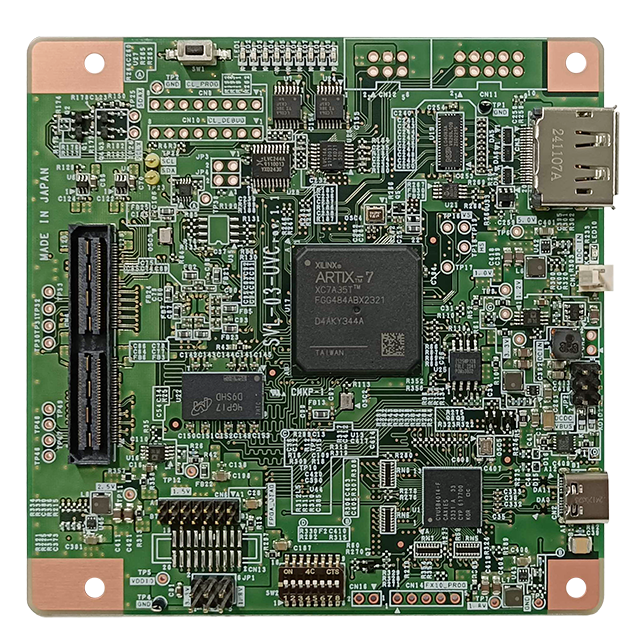
The SVL-03-UVC is a board for recording and displaying MIPI CSI-2 video signals. The input video can be output to a DisplayPort monitor and USB 3.2 Gen 2.
The SVL-03-UVC is a board developed by replacing the FX3, that is mounted on the SVM-06, with the EZ-USB™ FX10. With support for USB 3.2 Gen 2, it can now handle in-vehicle video transfer at 6 Gbps.
The transfer rate per MIPI lane is 1.5 Gbps per lane, supporting 4K video output.
The FPGA features two types: Lattice’s CrossLink, which supports MIPI D-PHY, and AMD Xilinx’s Artix-7. By using these two types of FPGAs appropriately, it can handle embedded data and multiple virtual channels.
Additionally, it has various functions such as capturing video from two sensors simultaneously to display them side by side, connecting multiple cameras to separate SVL-03-UVC boards, and synchronously capturing them on a PC.
The capture function supports both Windows and Linux environments. The main changes from SVM-06 to SVL-03-UVC are the shift to the EZ-USB™ FX series and the change from HDMI to DisplayPort. This board utilizes the same technology and know-how to maintain compatibility and convenience for our past users.
Characteristics
- Input : MIPI CSI-2 1.5Gbps/lane
- Output : USB3.2-Gen2 or DisplayPort
- Supports 6Gbps band in-vehicle deserializer
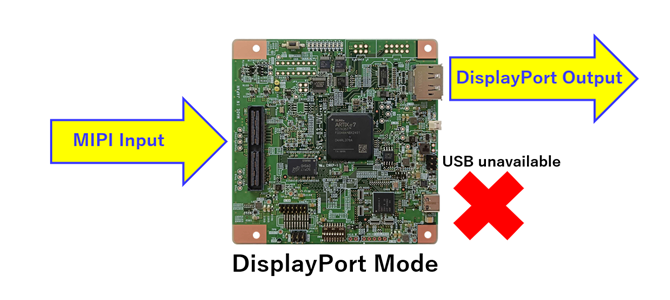
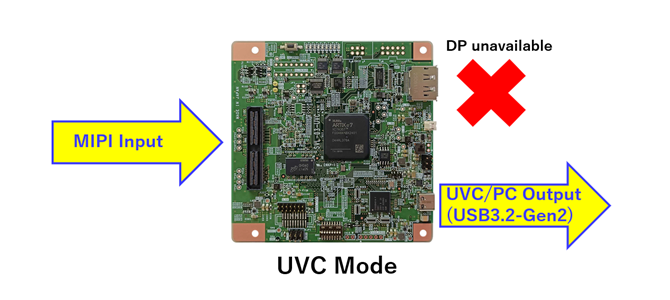
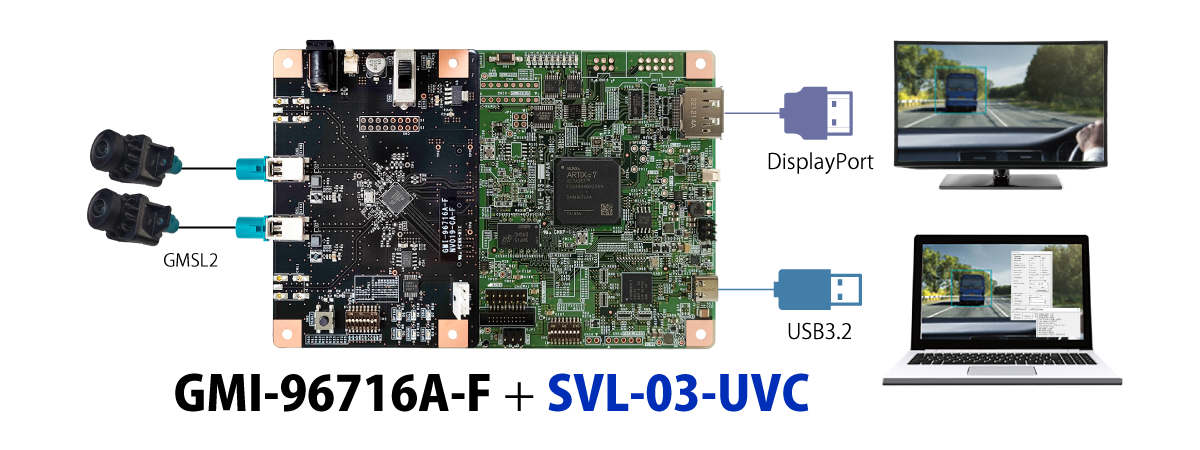
Configuration Example
Specification
| Item | Specification | Remarks | |
|---|---|---|---|
| Video Input Interface | MIPI D-PHY CSI-2 video signal | Supports Non-Continuous / Continuous Clock Standard specification : 4 data lanes + 1 clock lane With customization : Supports up to 8 data lanes + 2 clock lanes Supports either 2 inputs or 1 input + 1 output |
|
| Video Output Interface | USB3.2 Gen2 / Gen1 (Windows UVC Driver) DisplayPort 1.1a |
(DisplayPort mode) Dual‑Mode (DP++):Not supported DPCP:None |
|
| Input Resolution | Max. 8190 x 4095 pixel | The supported input width depends on the number of lanes. | |
| Output Resolution | Max. 8190 x 4095 pixel (UVC mode Gen2) Within 6.0 Gbps (UVC mode Gen1) Within 3.0 Gbps (DisplayPort mode) Up to 3840 × 2160, 30fps |
(UVC mode) Depends on the capture performance of the host PC. (DisplayPort mode) Supported standard resolutions: 1280 × 720 / 1920 × 1080 / 2560 × 1440 / 3840 × 2160 Custom resolution configuration file used on SVM‑06 is supported. (Common) Cropping and output of selected regions supported. For dot‑by‑dot output, the maximum effective data rate is 5.2 Gbps (YUV422 8bit, when using frame memory). Maximum values vary depending on output resolution and data type. |
|
| Sync Signal | Frame Start / Frame End | ー | |
| MIPI Data Lane | 1 ~ 4 lanes | ー | |
| Data Rate Per Lane | 20 ~ 1500 Mbps | Data rate per lane = Clock lane frequency x 2 | |
| Supported Pixel Format | YUV422 8bit / RGB24 / Raw8, 10, 12, 16, 20 |
ー | |
| Other Interface | I2C | 1 channel, Frequency:100 / 200 / 400 kHz / 1 MHz (hardware‑only setting) |
Voltage level follows VDDIO. |
| GPIO | 16bit, IN / OUT direction control for each bit. Direct connection to FPGA. | Voltage level follows VDDIO. | |
| Synchronous Connector | Synchronous signal input and output. IN / OUT direction control. |
Fixed at 1.8V. | |
| Power Supply | Input Power | USB bus power / Dedicated 2pin connector | The dedicated 2pin connector supports an input range of 5V ~ 5.5V / 6.5V ~ 16V, selectable via jumper pins. USB bus power can be disconnected using jumper pins. |
| Output Power | VDDIO output(1.8V, 2.5V, 3.3V) 1.2V, 3.3V, 5V output |
VDDIO:IO power supply setting Using the common internal power supply. Current rating:1.2A(VDDIO), 1.2A(3.3V), 3.0A(5V), reserved(1.2V) |
|
| Protection Device | eFuse 6V / 4.8A (TCKE805NL) | Recovery by turning board power OFF. | |
| Other Function | Test pattern output Image clipping Automatic I2C transmission at startup (ROM boot) Virtual Channel, Embedded Line |
ー | |
| Interface Connector | 120 pin (QSH-060-01-L-D-A) | Connectable in the same way as SVM‑06. | |
| FPGA | Artix-7 (XC7A35T) CrossLink (LIF-MD6000) |
ー | |
| Frame Memory | 256 MByte (DDR3-SDRAM) | ー | |
| USB | Device Controller | Infineon EZ-USB FX10 | ー |
| Connector | USB3.2 Gen2 Type-C | ー | |
| Dimensions | Length x Width x Height = 101.6 x 101.6 x 24.0 (mm) |
Including spacer (10mm) in height. | |
| Software (Windows) | NVCap, SVLCtl, SVLUpdater | ー | |
| Supported Our Deserializer Board | GMI-96716A-F, GVI-4960-F, FPI-954-HF, etc. | ー | |
Documents
Design Documents
- SVL-03-UVC Hardware Specification (PDF)
- SVL-03 IF Schematics (PDF)
- SVLCtl Software Manual (PDF)
- NVCap Software Manual (PDF)
Full Package Download
MIPI Monitoring Board Evaluation Kit
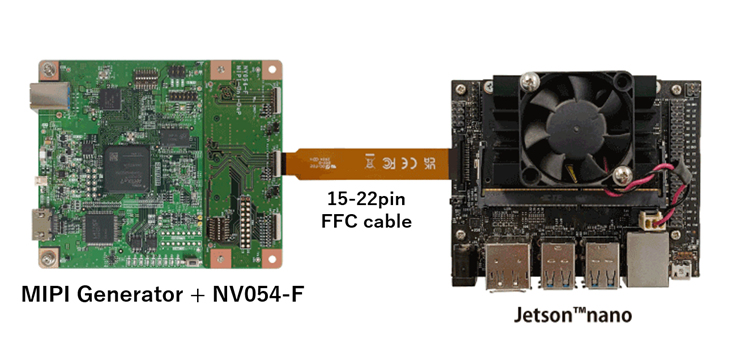
As shown in the image, it is possible to connect and use a Raspberry Pi Camera using the "NV054-F". We can also provide a configuration file for camera operation.
*Raspberry Pi camera and cable are not included.
Application
Display video signal of camera modules or CMOS sensors to DisplayPort monitor, Around view development, Simultaneous monitoring of multiple sensors.
Application Areas
Automotive / transportation equipment, medical testing / analysis / measurement, IT / information / communications, software, education / research institutions, and so on.