
RP2040 MIPI Connection Expansion Board
RP2040-Uni-Conn: NV070-B
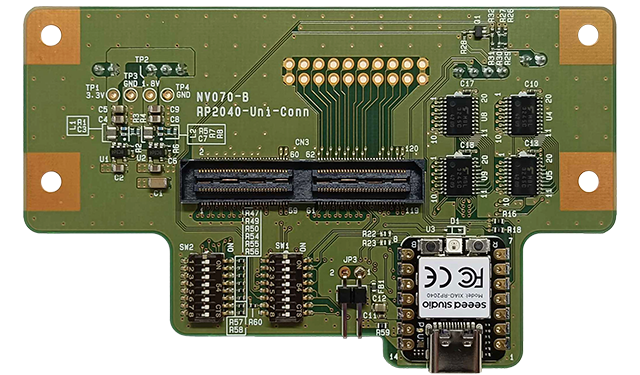
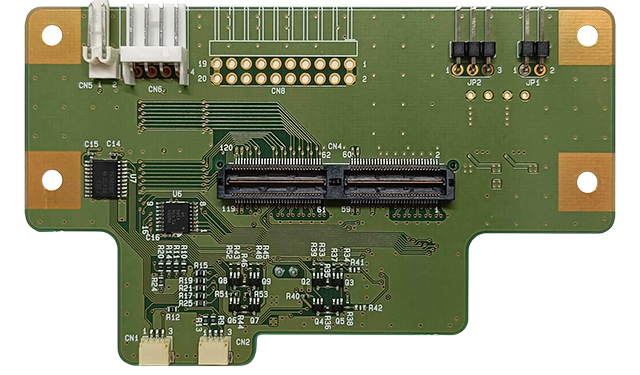
The NV070‑B is a board equipped with the XIAO RP2040. When used together with our main boards and SerDes boards, it allows users to customize I2C control, I2C slave response, GPIO control, and other functions according to their evaluation requirements.
This board is designed for flexible control applications tailored to various evaluation environments, such as SerDes evaluation, camera ECU evaluation, and standalone control during EMC testing.
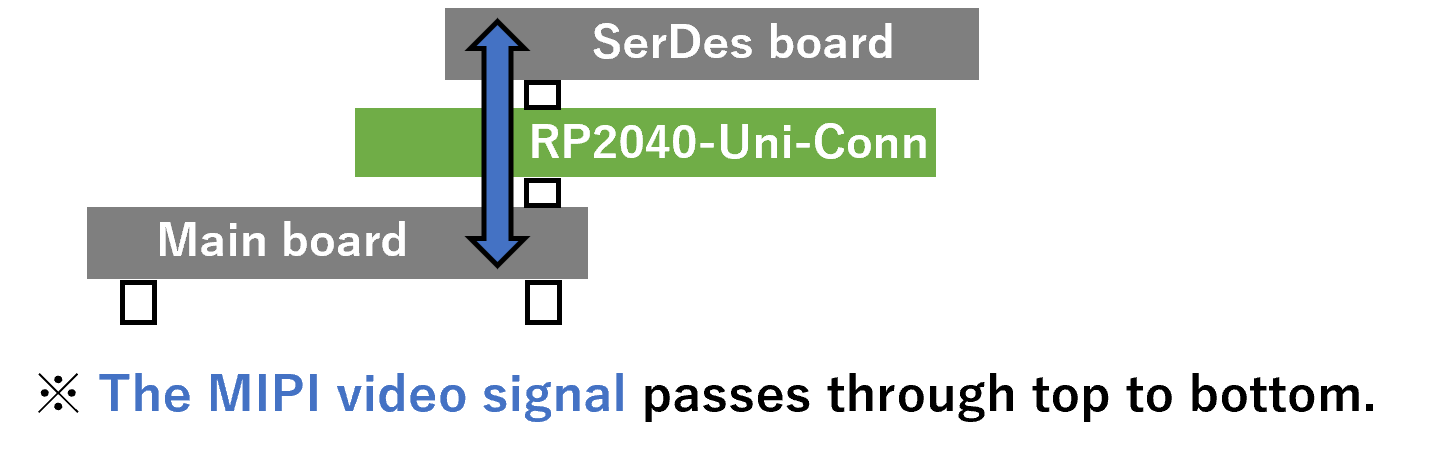
The following samples are provided:
- I2C Master Sample (MicroPython)
- I2C Slave Sample (Pico SDK‑based)
These samples serve as a basis for customizing the firmware to match specific evaluation targets and control sequences.
Connection Examples
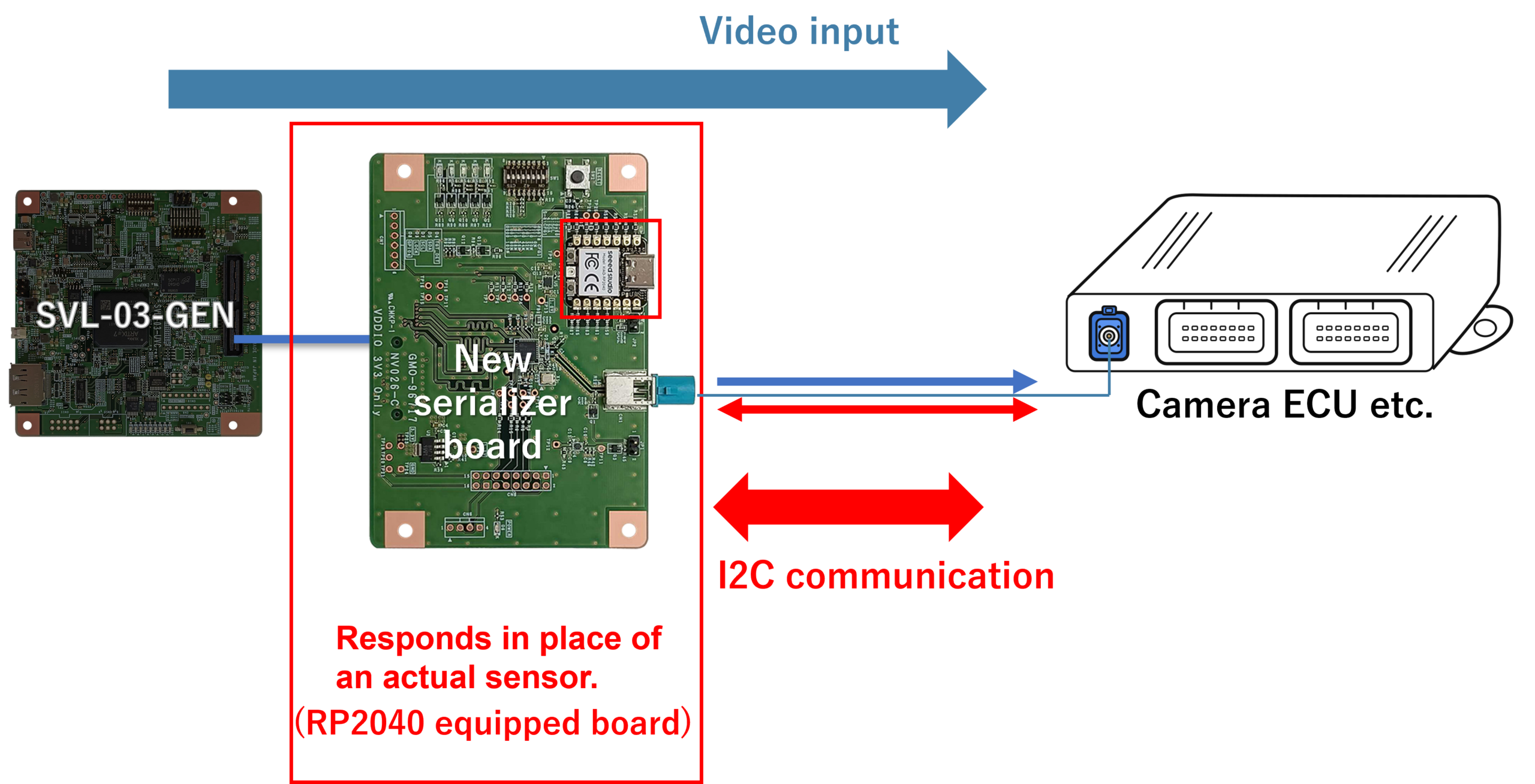
Simulates sensor I2C responses with the serializer board
By connecting the NV070‑B to the serializer board and implementing an I2C slave response on the RP2040, sensor‑side I2C behavior can be simulated. This is useful in evaluation setups where devices such as camera ECUs read sensor information over I2C during startup, allowing any required responses to be returned in place of an actual sensor.
A Pico SDK–based I2C slave sample is provided, which can be customized to match specific evaluation targets and response requirements.
Configuration example
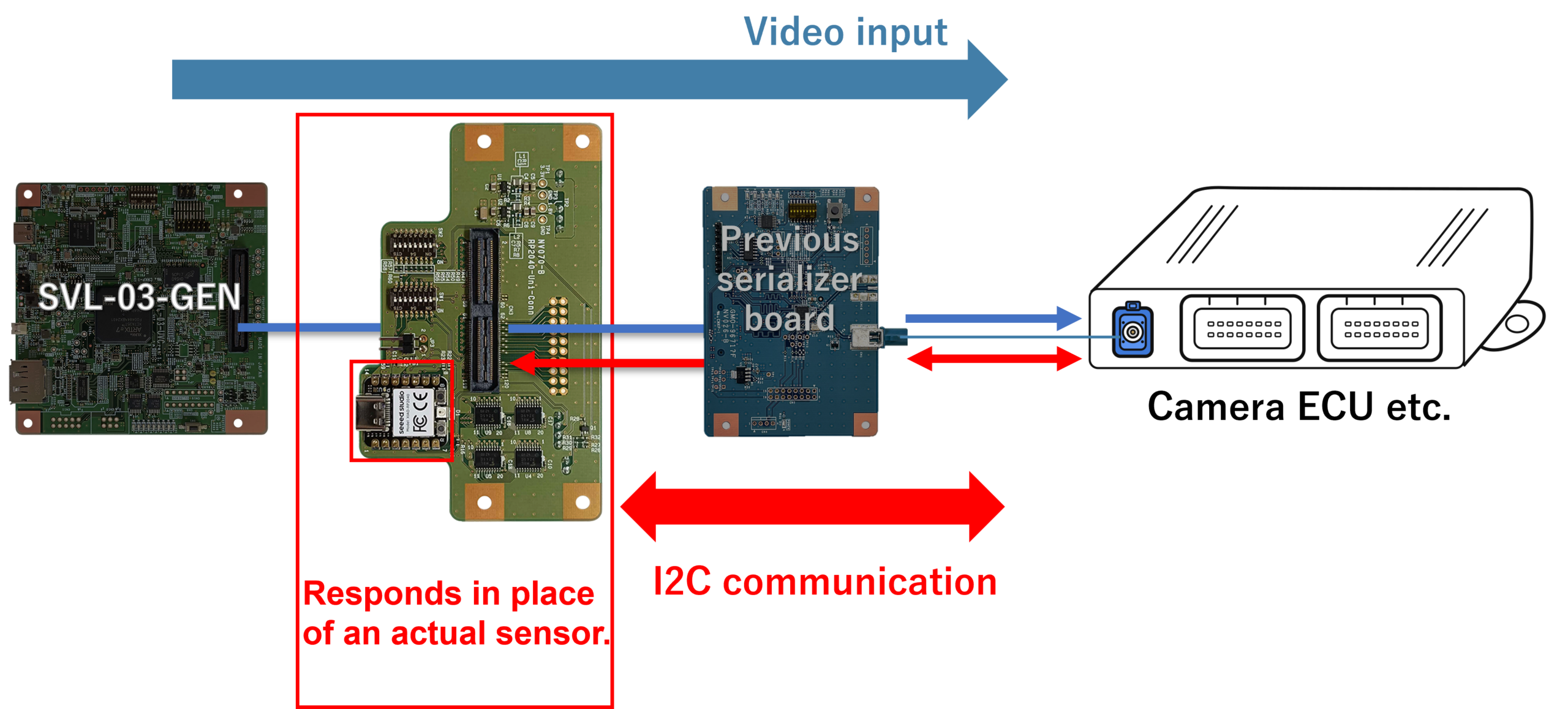
Serializer boards are now designed with a pre‑installed XIAO RP2040. As shown in the figure below, this configuration enables customization of I2C responses and control processing equivalent to the functions provided by the NV070‑B, without requiring an additional board.
Application
- Startup verification of the camera ECU.
- Emulation of the sensor‑detection sequence.
- Initial evaluation without an actual sensor.
- Building an evaluation environment that returns any I2C responses.
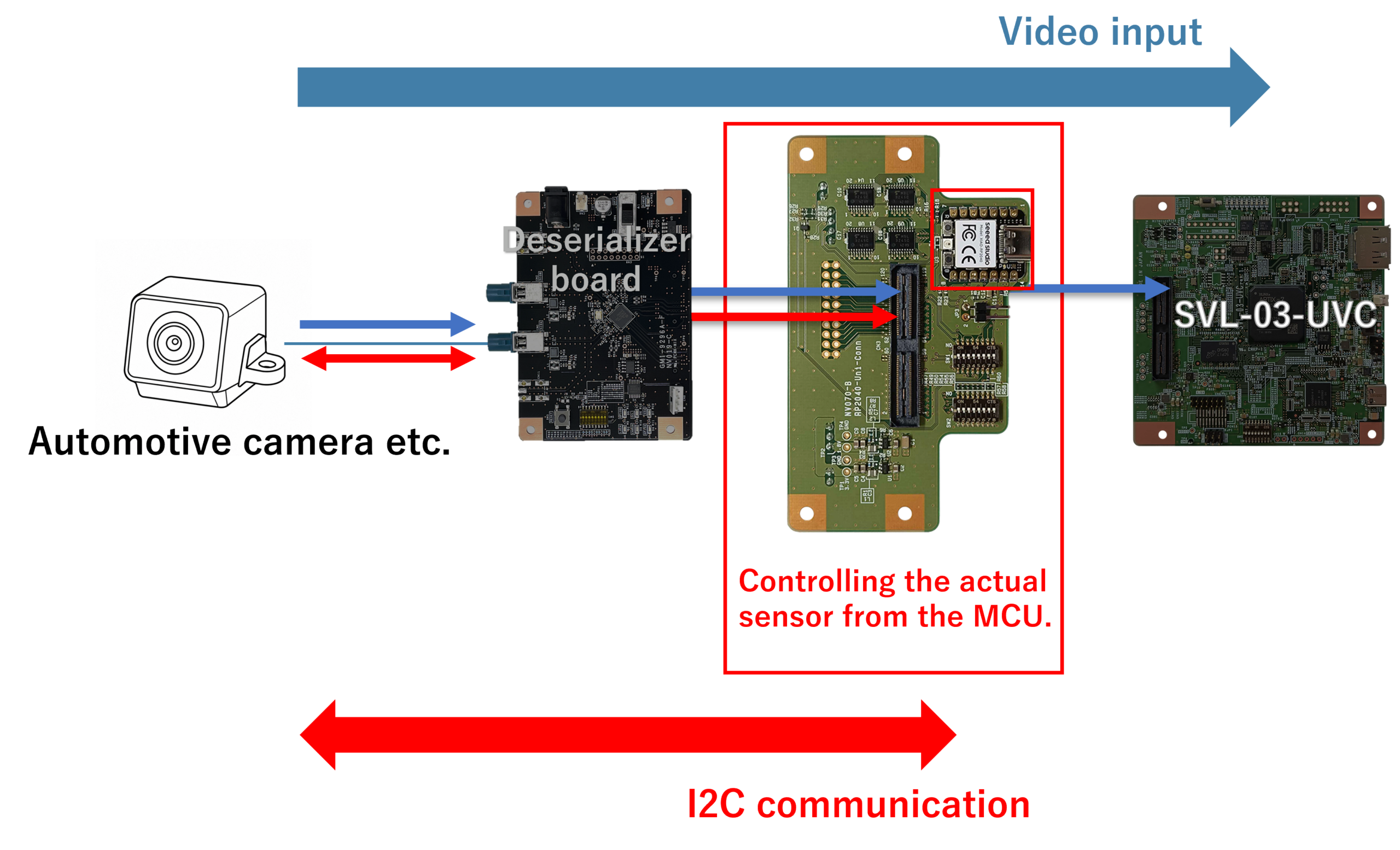
EMC testing in combination with the deserializer board
The NV070‑B can assist in controlling cameras and SerDes interface devices when connected to the deserializer board and operated through I2C control from the RP2040.
In environments such as EMC testing where PC and evaluation board connections are limited, standalone evaluation is enabled by implementing the required initialization and control processing on the NV070‑B.
For example, the board can be used in configurations that verify video output via HDMI without connecting a PC, or in evaluations that measure the elapsed time after camera startup.
By customizing the I2C control processing and GPIO control processing according to the evaluation target and test items, the system can flexibly support test conditions that are difficult to handle with standard evaluation environments.
Configuration example
Application
- Assisting camera control during EMC testing.
- Building an evaluation environment with limited PC connections.
- Initialization control of cameras and SerDes devices.
- Implementing I2C control processing according to the evaluation conditions.
Flexible firmware customization with RP2040
The NV070‑B is equipped with a XIAO RP2040, allowing customers to create and modify control programs according to their evaluation needs.
Its use of the same RP2040 series as the Raspberry Pi Pico provides easy access to existing development resources and enables firmware development using MicroPython or the Pico SDK. For each application, a custom evaluation environment can be configured by combining I2C control processing, I2C slave responses, and GPIO control.
I2C Master / Slave control
The NV070‑B allows implementing configurations in which the RP2040 controls the I2C bus or responds to I2C accesses from external devices.
It can be used for applications such as the following:
- I2C control of cameras and SerDes devices.
- Sensor‑response emulation for I2C accesses from the ECU.
- Implementation of initialization sequences tailored to the evaluation target.
- Functional verification combining I2C control and GPIO control.
Using the samples provided by us as a reference, the response behavior and control processing can be modified to match the evaluation requirements.
GPIO control and I/O expansion
The NV070‑B provides a configuration that allows the GPIO signals on the SV board to be connected to the RP2040. It also supports GPIO control via the I/O expander, enabling the generation and switching of control signals according to the evaluation target.
It can be used for applications such as the following:
- Reset signal control.
- High/Low switching of control pins.
- Simulation of interrupt and status signals.
- Evaluation combining I2C control and GPIO control.
Standalone operation
The NV070‑B can be used in a standalone configuration without connecting the SV board. By implementing the required control processing on the RP2040, it allows evaluation setups with fewer PC or evaluation board connections.
In environments such as EMC testing, where the number of connected devices is limited, this board can serve as an auxiliary board for controlling cameras and SerDes interface devices.
Firmware sample
The following firmware samples are provided for the NV070‑B.
| Sample | Description | Application |
|---|---|---|
| MicroPython I2C Master sample | Control example for accessing an I2C device from RP2040. | Control of cameras, SerDes devices, and peripheral ICs. |
| Pico SDK I2C Slave sample | Response example for operating RP2040 as an I2C slave. | Simulation of responses to I2C access from the ECU. |
These samples are not complete applications. They are intended to be customized and used in the customer’s evaluation environment.
| Item | Description |
|---|---|
| Model number | NV070-B |
| Product name | MIPI-Uni-Conn |
| MCU | XIAO RP2040 |
| Main functions | I2C control, I2C slave responses, GPIO control, Standalone operation |
| Supported I/O voltage | DC +1.8V ~ +3.3V |
| Board dimensions | 101.6 × 62.0 mm |
| SV board connection | CN4 |
| Target / SerDes connection | CN3 |
| USB connection | XIAO RP2040 Type-C |
| Others | Equipped with a circuit and connector for detecting 5V ~ 16V camera power (CN5) |
Please contact us for information regarding the connection configurations, usage, sample firmware, and SerDes board compatibility of the NV070‑B.
Support for implementation strategies such as I2C control, I2C slave responses, and GPIO control can also be provided according to the evaluation target and connection configuration.